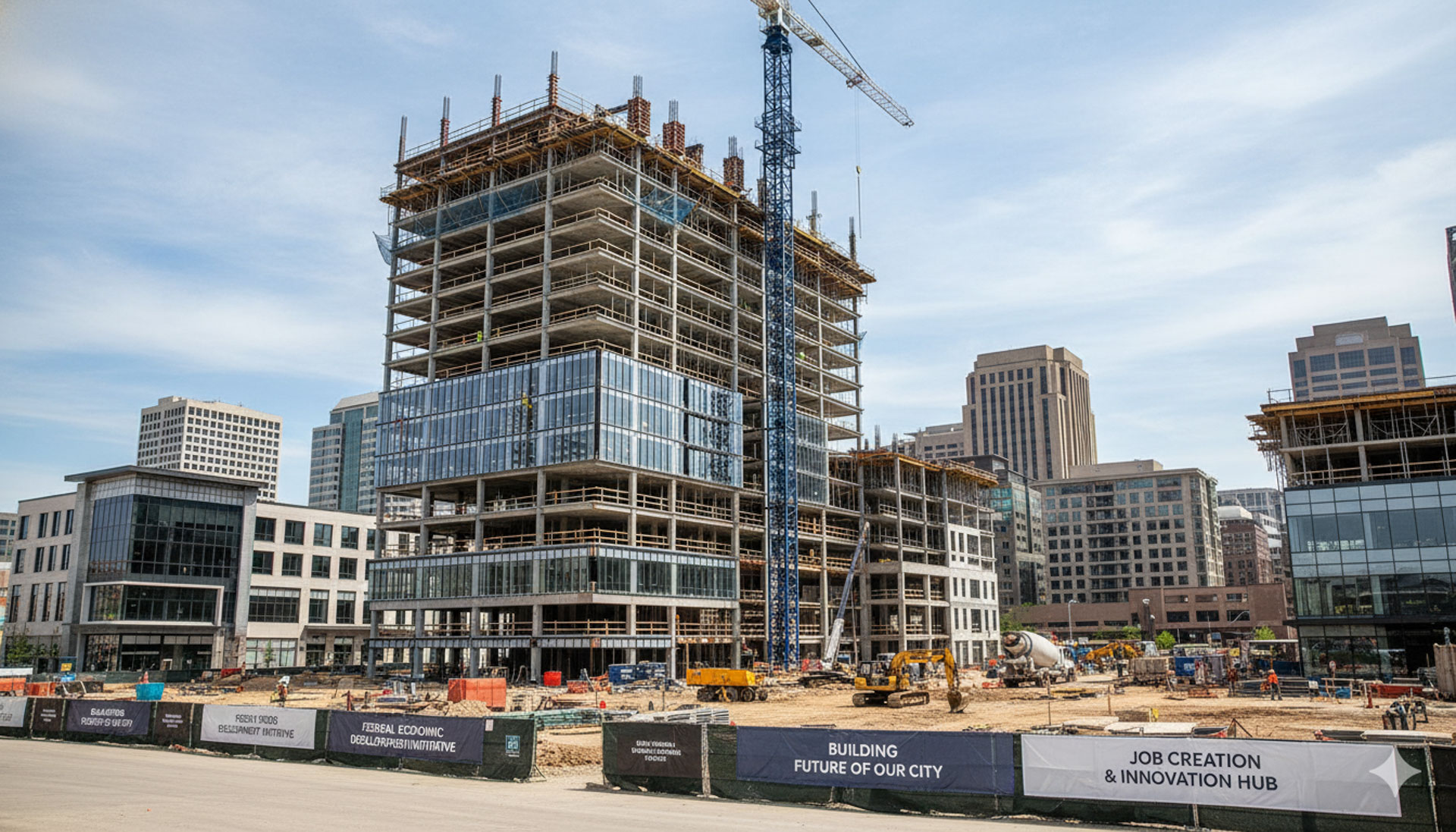
Bellevue achieved a significant economic development milestone during early 2026, securing $1.73 million in federal funding from the Economic Development Administration to support business growth and job creation initiatives. This substantial investment, mentioned during the February 3, 2026 City Council meeting, positions Bellevue to attract new businesses, expand existing companies, and create employment opportunities that strengthen the local economy. For homeowners, federal economic development funding signals community growth potential that often precedes residential construction demand, rising property values, and improved commercial amenities serving residential neighborhoods.
The U.S. Economic Development Administration (EDA) provides competitive grant funding to communities demonstrating economic distress, growth potential, or strategic investment opportunities supporting regional economic development. EDA grants typically support infrastructure projects enabling business expansion, workforce training programs developing skilled labor pools, revolving loan funds providing capital to growing businesses, and planning initiatives identifying economic development strategies. Securing $1.73 million indicates that Bellevue successfully competed against other communities nationwide by demonstrating compelling investment opportunities and realistic plans for converting federal dollars into measurable economic growth.
For homeowners evaluating whether Bellevue represents a sound long-term residential investment, federal EDA funding approval provides strong signal that economic development professionals see growth potential in your community. When federal agencies invest significant capital, they've conducted due diligence verifying economic fundamentals, growth projections, and municipal capacity to successfully implement complex economic development programs. This third-party validation from federal economic development experts carries weight that local promotional claims alone cannot match.
Economic development funding typically aims to create or retain jobs while expanding the local tax base supporting municipal services. The $1.73 million investment will support initiatives that help existing businesses expand operations, attract new companies to locate in Bellevue, and develop workforce training programs ensuring residents possess skills demanded by employers. Brookings Institution research on economic development incentives shows that successful programs balance business attraction with existing business support while ensuring that job growth benefits local residents rather than primarily importing workers from elsewhere.
Homeowners benefit from local employment growth through multiple channels. First, employed neighbors maintain homes better and avoid foreclosure during economic downturns, supporting neighborhood property values. Second, growing employment increases housing demand as workers seek residences near jobs, creating upward pressure on home values and rental rates. Third, commercial development following employment growth brings retail, dining, and service businesses to areas near residential neighborhoods, improving convenience and quality of life for residents. When planning whether to invest in home improvements or custom home construction, consider how economic development trends affect long-term property value trajectories in different Bellevue neighborhoods.
EDA funding often supports infrastructure projects that enable business expansion but wouldn't occur through normal municipal budgeting. These might include utility extensions into undeveloped industrial areas, road improvements accessing business parks, fiber optic installation supporting technology-dependent industries, or stormwater management allowing development on previously constrained sites. Federal infrastructure investment leverages private development that wouldn't occur without public infrastructure enabling business operations.
Infrastructure improvements supporting commercial development also benefit nearby residential areas through enhanced public facilities, improved traffic flow, better utility reliability, and sometimes shared-use amenities like trails or parks incorporated into mixed-use development projects. Homeowners should monitor how infrastructure investments funded by economic development grants affect neighborhoods, as commercial development patterns strongly influence residential desirability, traffic patterns, and property values in surrounding areas.
Part of Bellevue's $1.73 million federal funding may support workforce development programs partnering with employers to train residents for available jobs. These programs address the common disconnect where businesses report difficulty finding qualified workers while residents lack training for available positions. Department of Labor workforce development research shows that successful programs combine employer input defining needed skills, training curricula matching industry requirements, and support services helping participants overcome barriers to employment.
For homeowners, workforce development programs benefit the community even if your household doesn't directly participate. When more residents gain employment and advance to higher-paying positions, neighborhood economic stability improves. Working residents maintain properties better, participate more actively in community organizations, and contribute to the social fabric making neighborhoods desirable places to live. The collective economic advancement that workforce development enables creates rising tide effects that lift property values across entire communities.
Successful economic development initiatives expand the commercial and industrial tax base supporting municipal services without proportionally increasing residential property taxes. When businesses grow and new companies locate in Bellevue, their property taxes, sales taxes, and occupation taxes generate revenue supporting police, fire, parks, libraries, and infrastructure maintenance serving both commercial and residential areas. The Lincoln Institute of Land Policy research on property tax policy shows that communities with balanced commercial/residential tax bases can provide higher service quality at lower residential tax rates than communities depending primarily on residential property taxation.
Homeowners should appreciate that commercial development supported by economic development funding helps control residential property tax increases by diversifying revenue sources. When your community attracts businesses generating tax revenue, municipal budgets can maintain or expand services without proportionally increasing homeowner tax burdens. This tax base diversification protects homeowner budgets while maintaining the service quality that supports residential property values and community appeal.
Bellevue competes with surrounding communities for business location, employment growth, and economic development investment. Securing $1.73 million in federal EDA funding indicates that Bellevue successfully competed against other Nebraska communities and potentially regional competitors in Iowa and Missouri for limited federal dollars. This competitive success signals that federal evaluators found Bellevue's economic development strategy, project proposals, and implementation capacity more compelling than alternatives they considered funding.
For homeowners considering whether Bellevue represents a smart long-term residential investment compared to surrounding communities, this competitive economic development success provides evidence that professional economic development evaluators see stronger growth potential here than in competing jurisdictions. While no single data point should drive major investment decisions, federal funding awards contribute to the mosaic of evidence helping homeowners evaluate where to invest in home improvements, where to purchase properties, and where to build custom homes within the metro area.
Federal EDA grants include performance requirements measuring whether funded programs achieve intended outcomes. Typical metrics include jobs created or retained, businesses assisted, private investment leveraged, and economic indicators like increased tax revenue or reduced unemployment. Bellevue must report these outcomes to EDA, providing transparency about whether federal investment delivers promised results. The EDA annual reporting demonstrates accountability that federal economic development funding entails.
Homeowners can access information about economic development program outcomes through municipal reports, council meetings, and economic development organization communications. Understanding how federal investment translates to concrete results—new jobs, business expansions, infrastructure improvements—helps you evaluate whether economic development initiatives deliver value supporting community growth and property values. Follow Bellevue's economic development progress through the city's website and business development organization communications. For homeowners ready to invest in their properties, contact experienced local contractors who understand how community economic development trends create opportunities for residential construction, renovation, and property value appreciation across Bellevue's growing neighborhoods.